Since we advise beginner users to keep a list of commands on file, and it even has such article in the wiki i decided to share with you my list of frequently used command. However, i decided i want it a bit more fancy and interactive, so i made it in form of a dialog menu. Here it is, my menu.sh
ver. 12.02.2026
#!/bin/bash
# Creator: Todor Uzunov a.k.a. Teo
# License: GNU - free like free speech and free beer for everybody!
# https://forum.manjaro.org/t/my-manjaro-cheatsheet-in-a-menu-form/145943
# For the referenced external scripts check my other topics in the manjaro forum.
VERSION=10.02.2026
# Changelog from last version: restructuring the script to remove numeric tags; fixed cleaning of alpm download folders; rearranged the order of some commands; added theme variable
# Check if dependencies are present and ask for installation if not
if ! [[ "$(which dialog)" =~ (dialog) ]] &>/dev/null; then
echo "dialog dependency is not found, please install: sudo pacman -S dialog"
exit 1
fi
# Set custom theme if there is one
export DIALOGRC=/home/$USER/.dialogrctheme
OPTIONS=(
"pacman-mirrors" "Mirror Sync status and branch"
"sudo pacman-mirrors -f" "Refresh the mirror list" # sudo pacman-mirrors --country Germany --api --protocol https
"sudo pacman -Syu" "Update all without AUR"
"sudo pacman -Syuw" "Download all updates for offline install later"
"pamac update --aur --force-refresh" "Force refresh and fix AUR database in pamac"
"DIFFPROG=meld pacdiff -s" "Run pacdiff with Meld to compare changed configs" # pamac install meld
"pacman -Qm" "List foreign (AUR) packages"
"pacman -Qdt" "List orphaned packages"
"yay -Qua" "Check for updates of AUR with YAY, do not update" # pamac install yay
"yay -Sua" "Update only AUR packages with YAY" # pamac install yay
"pamac update --aur" "Pamac update AUR packages"
"sudo pacman -Rsu \$(pacman -Qtdq)" "Remove orphaned packages"
"yay -Scc" "Clean YAY, Pacman and Pamac cache" # pamac install yay
"sudo rm /var/cache/pacman/pkg/download*/*; sudo rmdir /var/cache/pacman/pkg/download*" "Remove the temporary download cache folders from ALPM" # if yay -Scc errors out on download folders
"flatpak update" "Check for flatpak updates and update"
"flatpak uninstall --unused" "Remove orphaned (unused) flatpak runtimes"
"rm -rfv /var/tmp/flatpak-cache-*" "Clean flatpak cache"
"journalctl -b -p3 --no-pager" "Show journal errors from current boot"
"journalctl -b -1 -p3 --no-pager" "Show journal errors from previous boot"
"journalctl -b -t systemd" "Show systemd bootlog only"
"journalctl -k" "Show kernel log"
"coredumpctl" "Check for coredumps"
"sudo rm -f /var/lib/systemd/coredump/*" "Clear coredumps on disk" #normally runs biweekly automatically
"sudo /root/verifier.sh -update" "Regenerate hashes for the boot files after update" # requires the extra script, see https://forum.manjaro.org/t/utility-script-my-take-on-a-verified-boot/164729
"sudo updatedb" "Update database for locate" #normally run weekly automatically
"sudo fstrim -v /" "Trim the root of the SSD" #normally run weekly automatically
"sudo smartctl --all /dev/nvme0" "S.M.A.R.T. status of the disk and write cycles" # smartctl --scan
"inxi -zv8" "Gather system info with inxi (filtered)"
"wavemon" "Run wavemonitor to check Wifi channel and strength" # pamac install wavemon
"nmcli dev wifi" "List wifi networks around with strength and channel"
"bash <(curl -s https://gitlab.com/cscs/mapare/-/raw/main/mapare) -IP" "Use MAPARE to check if missing default packages"
"sudo pacman -Qk 2>/dev/null | grep -v ' 0 missing files' " "Check for missing files from packages"
"read fileowner; pacman -Qo \$fileowner" "Which package owns an existing file (paste filepath)"
"read whogotit; sudo pacman -Fyx \$whogotit" "Which (installed or not) package contains a file (paste filename, online check)"
"read whogotit; pacman -Qo \$whogotit" "Which (installed) package contains a file or directory (paste filename or path, offline check)"
"\$HOME/Applications/appimageupdater5.sh" "Check Appimage and Github Apps for updates" # requires the extra script, see https://forum.manjaro.org/t/automate-update-checks-for-externally-downloaded-software-in-tar-gz-or-appimage/161008
"rm -f ~/.bash_history-*.tmp" "Clean tmp bash history files"
"rm -f ~/.cache/totem/stream-buffer/*" "Clean Totem stream cache"
"du -sh -t +100M ~/.cache/* ~/.config/* ~/.local/share/*" "Show hidden spaceeaters above 100M in HOME"
"journalctl --disk-usage" "Show journal size"
"sudo journalctl --vacuum-time=2weeks" "Cut journal to 2 weeks" # that probably also sets it fixed on 2 weeks
"sudo nethogs" "Display the apps making most network traffic. Exit with q" # pamac install nethogs
"sudo netscanner" "Netscanner. Exit with q" # pamac install netscanner
"read nethog; ss -tuap | grep \$nethog" "Show all network connections of an app (paste name or pid)"
"read ipaddress; whois \$ipaddress" "Whois (paste ip address)"
"sudo netstat -tulpn" "List all processes, listening on a network port"
"time echo \"scale=5000; 4*a(1)\" | bc -l > /dev/null" "A 10-20 sec. cpu benchmark using bc to calculate PI" # pamac install bc
"watch -e -n 1 sensors" "Read sensors every second, press CTRL-C to exit"
"stress -c 16" "Stress the CPU, useful for thermal or throttling tests, CTRL-C to exit"
"vnstat -d --style 0 --limit 5 | grep -v estimated && vnstat -m --style 0 --limit 3 | grep -v estimated" "Traffic statistic for the last days and current month (vnstat)" # install vnstat and start daemon
"sudo sysz" "Fuzzy search in systemd services. Exit with esc" # pamac build sysz
"systemctl start --user spotlight.service" "Spotlight background refresh" # requires the extra script, see https://forum.manjaro.org/t/spotlight-wallpaper-changer-for-xfce/181665
"xfce4-terminal --hold -e \"journalctl -t spotlight --no-pager\"" "Spotlight background info" # requires the extra script, see above or https://github.com/teou1/spotlight-xfce/
"sudo conservation_mode.sh 0" "Temporary disable Ideapad battery conservation mode" # pamac build conservation_mode
)
while true; do
CHOICE=$(dialog --clear \
--no-shadow \
--keep-tite \
--scrollbar \
--ok-label "Press Enter to run command" \
--cancel-label "Press ESC to exit" \
--cursor-off-label \
--backtitle "" \
--title "A Manjaro cheatsheet by Teo, version $VERSION" \
--menu "Press Enter to run a command from the list; hit Esc or close the window to exit:" \
79 185 0 \
"${OPTIONS[@]}" \
2>&1 >/dev/tty)
[[ $CHOICE ]] || break
echo "$CHOICE"
echo ""
eval "$CHOICE"
echo ""
read -n 1 -s -r -p "Press any key to return to menu or q to exit." REPLY;
echo ""
echo ""
echo "================================================="
echo ""
if [[ $REPLY == "q" ]]; then break; fi
done
P.s. for the beginner users: save it as a file menu.sh in the ~/.local/bin hidden Folder (create if needed) then right click and in the permissions tab in properties select allow to execute as a program.
Then you can start in the terminal with menu.sh. You can even make a launcher on the panel, just don’t forget to set it to run in terminal and append -launcher at the end of the command. And if some subcommand does not work, check if you have the dependency in the comment on the corresponding line. Like this in a XFCE panel:
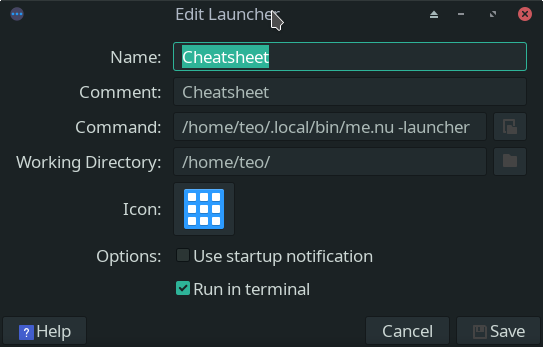
The most recent version you can find here or at github
If for some reason, the default colours are not to your liking, one can easily theme dialog. Here is an example black-red theme. Just put the file as .dialogrctheme in your home.
.dialogrctheme - red-black theme
#
# Run-time configuration file for dialog
#
# Automatically generated by "dialog --create-rc <file>"
#
#
# Types of values:
#
# Number - <number>
# String - "string"
# Boolean - <ON|OFF>
# Attribute - (foreground,background,highlight?,underline?,reverse?)
# Set aspect-ratio.
aspect = 0
# Set separator (for multiple widgets output).
separate_widget = ""
# Set tab-length (for textbox tab-conversion).
tab_len = 0
# Make tab-traversal for checklist, etc., include the list.
visit_items = OFF
# Show scrollbar in dialog boxes?
use_scrollbar = OFF
# Shadow dialog boxes? This also turns on color.
use_shadow = ON
# Turn color support ON or OFF
use_colors = ON
# Screen color
screen_color = (black,black,Off)
# Shadow color
shadow_color = (BLACK,BLACK,Off)
# Dialog box color
dialog_color = (white,black,off)
# Dialog box title color
title_color = (red,black,Off)
# Dialog box border color
border_color = (WHITE,black,Off)
# Active button color
button_active_color = (white,red,Off)
# Inactive button color
button_inactive_color = dialog_color
# Active button key color
button_key_active_color = button_active_color
# Inactive button key color
button_key_inactive_color = (RED,black,OFF)
# Active button label color
button_label_active_color = (white,red,Off)
# Inactive button label color
button_label_inactive_color = (BLACK,WHITE,ON)
# Input box color
inputbox_color = dialog_color
# Input box border color
inputbox_border_color = dialog_color
# Search box color
searchbox_color = dialog_color
# Search box title color
searchbox_title_color = title_color
# Search box border color
searchbox_border_color = border_color
# File position indicator color
position_indicator_color = title_color
# Menu box color
menubox_color = dialog_color
# Menu box border color
menubox_border_color = border_color
# Item color
item_color = dialog_color
# Selected item color
item_selected_color = button_active_color
# Tag color
tag_color = title_color
# Selected tag color
tag_selected_color = button_label_active_color
# Tag key color
tag_key_color = button_key_inactive_color
# Selected tag key color
tag_key_selected_color = (white,red,Off)
# Check box color
check_color = dialog_color
# Selected check box color
check_selected_color = button_active_color
# Up arrow color
uarrow_color = (white,WHITE,ON)
# Down arrow color
darrow_color = uarrow_color
# Item help-text color
itemhelp_color = (WHITE,BLACK,OFF)
# Active form text color
form_active_text_color = button_active_color
# Form text color
form_text_color = (WHITE,black,ON)
# Readonly form item color
form_item_readonly_color = (CYAN,black,ON)
# Dialog box gauge color
gauge_color = title_color
# Dialog box border2 color
border2_color = dialog_color
# Input box border2 color
inputbox_border2_color = dialog_color
# Search box border2 color
searchbox_border2_color = dialog_color
# Menu box border2 color
menubox_border2_color = dialog_color
By the way, if you use xfce, you can make your desktop shortcut on the panel a bit fancier, for example the terminal can be automatically maximized, etc.:
xfce4-terminal --maximize --title=Cheatsheet --hide-menubar --hide-toolbar -e "/home/teo/.local/bin/cheatsheet4.sh"
And another, more manjaro like theme:
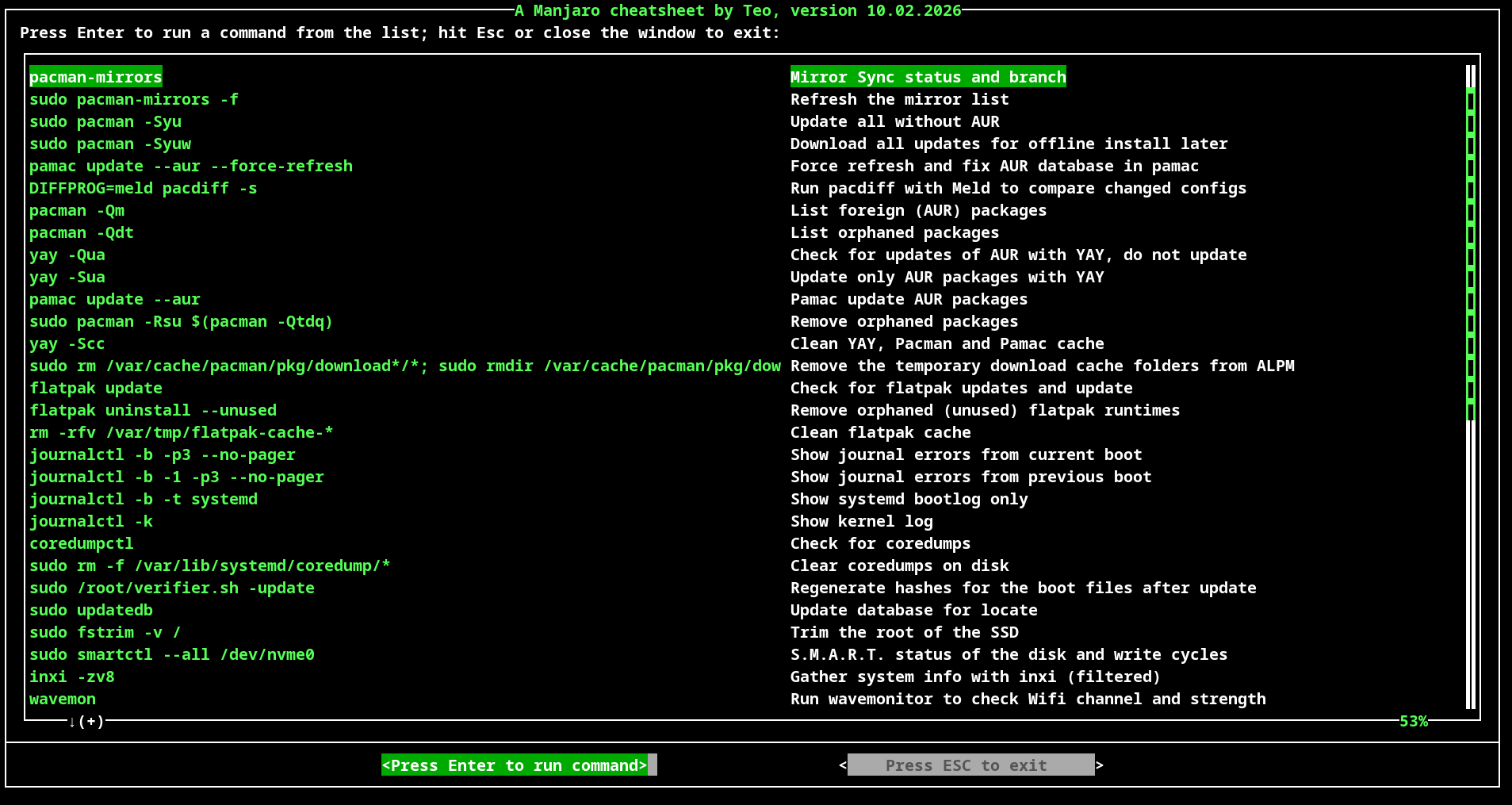
.dialogrctheme-lightgreen
#
# Run-time configuration file for dialog
#
# Automatically generated by "dialog --create-rc <file>"
#
#
# Types of values:
#
# Number - <number>
# String - "string"
# Boolean - <ON|OFF>
# Attribute - (foreground,background,highlight?,underline?,reverse?)
# Set aspect-ratio.
aspect = 0
# Set separator (for multiple widgets output).
separate_widget = ""
# Set tab-length (for textbox tab-conversion).
tab_len = 0
# Make tab-traversal for checklist, etc., include the list.
visit_items = OFF
# Show scrollbar in dialog boxes?
use_scrollbar = OFF
# Shadow dialog boxes? This also turns on color.
use_shadow = ON
# Turn color support ON or OFF
use_colors = ON
# Screen color
screen_color = (black,black,Off)
# Shadow color
shadow_color = (BLACK,BLACK,Off)
# Dialog box color
dialog_color = (white,black,on)
# Dialog box title color
title_color = (green,black,On)
# Dialog box border color
border_color = (WHITE,black,On)
# Active button color
button_active_color = (white,green,On)
# Inactive button color
button_inactive_color = dialog_color
# Active button key color
button_key_active_color = button_active_color
# Inactive button key color
button_key_inactive_color = (green,black,On)
# Active button label color
button_label_active_color = (white,green,On)
# Inactive button label color
button_label_inactive_color = (BLACK,WHITE,ON)
# Input box color
inputbox_color = dialog_color
# Input box border color
inputbox_border_color = dialog_color
# Search box color
searchbox_color = dialog_color
# Search box title color
searchbox_title_color = title_color
# Search box border color
searchbox_border_color = border_color
# File position indicator color
position_indicator_color = title_color
# Menu box color
menubox_color = dialog_color
# Menu box border color
menubox_border_color = border_color
# Item color
item_color = dialog_color
# Selected item color
item_selected_color = button_active_color
# Tag color
tag_color = title_color
# Selected tag color
tag_selected_color = button_label_active_color
# Tag key color
tag_key_color = button_key_inactive_color
# Selected tag key color
tag_key_selected_color = (white,green,On)
# Check box color
check_color = dialog_color
# Selected check box color
check_selected_color = button_active_color
# Up arrow color
uarrow_color = (white,WHITE,ON)
# Down arrow color
darrow_color = uarrow_color
# Item help-text color
itemhelp_color = (WHITE,BLACK,On)
# Active form text color
form_active_text_color = button_active_color
# Form text color
form_text_color = (WHITE,black,ON)
# Readonly form item color
form_item_readonly_color = (CYAN,black,ON)
# Dialog box gauge color
gauge_color = title_color
# Dialog box border2 color
border2_color = dialog_color
# Input box border2 color
inputbox_border2_color = dialog_color
# Search box border2 color
searchbox_border2_color = dialog_color
# Menu box border2 color
menubox_border2_color = dialog_color


