I’ve been working with this release for some time and I’ve been very happy with it, however I’ve noticed that it hasn’t received any package updates in a while (I think last serious update was sometime in August).
Once a system (any flavor) has been installed
it just needs to be updated.
I do not know whether the Sway edition has got an update indicator - it probably does.
In any case, you can check by updating the list of mirrors and then initiating an update: sudo pacman-mirrors -f
I use mirrors in my country : sudo pacman-mirrors -c germany
Thanks. Updating the mirrors didn’t help. I also see that the last stable update for Manjaro was in September. I’m definitely on the stable branch, never did anything to change that. I guess everything’s in order then.
Not so sure what you mean with stable update, so can’t comment on that, but:
I am really happy with the state of Manjaro Sway. We only have ~two hand full of custom packages and I update them relatively regularly when there’s new releases.
Sway itself isn’t super fast-moving, so there just isn’t a lot to be “updated” frequently, other than regular arch-updates coming in via the regular manjaro updates. Are you receiving those?
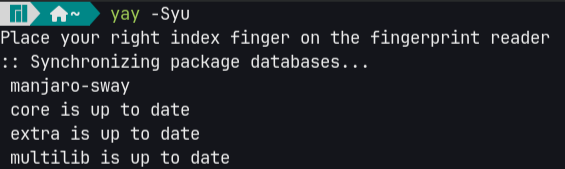
If everything is in order, this is, what for example yay -Syu should yield:
No. I am using it on a daily basis. As long as I do, I wouldn’t cease supporting it.
P.S.: I can by the way only recommend going “unstable”. Contrary to the name, that has been my stable daily driver for years. Never saw a reason to stay “behind”.
PPS: Nearly all manjaro-sway specific updates have to be packaged too. As I use git to store the artifacts, you can easily look into the commit history to see what changed recently → Commits · manjaro-sway/packages · GitHub
If @acud is concerned about changing to Unstable branch, then they might want to look at switching to Testing branch instead. Testing branch is very stable, and it updates every week or so.
Stable branch updates on a (roughly) monthly basis. However, when a new Manjaro release is being prepared, it can be longer (sometimes 2 or 3 months) between updates as more thorough testing is required before the new official images are released.
To switch to Testing branch:
sudo pacman-mirrors --api --set-branch testing
or, to switch to Unstable branch:
sudo pacman-mirrors --api --set-branch unstable
After you changed the branch, rebuild the mirrorlist and update your packages:
Apologies but I’m not very familiar with the Arch/Manjaro package system nomenclature. I mean using the stock system configuration without any changes to pacman branches.
I suppose the lag is because Manjaro hasn’t had an update (?) recently? All I’ve been seeing for updates in the last 2-plus months has been updates to the arch keyring, signal desktop and firefox, nothing more. I understand that sway itself isn’t moving that much (I can’t ask for more at this point either). It is more the security updates, kernel updates and the linux-firmware updates that I’m after, and as I said, those haven’t been coming in through the usual pacman -Syyu since beginning of September.
Swapping over to the testing branch gives me 425 package updates tho. I guess I’ll stay there for now.
If you monitor the Stable Update Announcements you can always be aware of when the more important updates occur.
If you happen to use a feed reader of some kind, a little known forum feature is that by adding .rss to the end of a URL, it can be added to most feed reader applications.
This would allow you to easily know when a (Stable) Update announcement is published:
Nearly two months has been the longest that I can remember for a stable update to arrive. I already follow the RSS feeds, all three Update channels, but I can’t figure out what the showstoppers are.
Is there a list of bugs/packages/issues in testing, that prevent the release of the stable update?
Contemplating the testing branch
What are the downsides to testing branch? How stock Arch are they?
The respective Update announcement threads for each branch should normally be your first port of call for that type of information, otherwise (as is often the case) your guess is as good as ours.
You can, however, obtain a list of packages from any specific Manjaro ISO, if that helps. Find a link to any ISO on the Downloads page and add .pkgs to the end of the URL;
A reminder that Manjaro produces three (official) editions, and two of those (namely Gnome and Plasma) are making some rather huge transitions which will likely not be a walk in the park for all distributions.
With a comparatively small Team I’m sure Manjaro (proper) is doing it’s best to have all editions released in unison. With respect the Stable branch, sometimes it has to “lag behind” to ensure all editions are delivered in a similar state of readiness.
The branch “closest” to Arch Linux (Stable branch) is Manjaro (Unstable branch).
Remember too that despite Manjaro being based on Arch Linux, it is not Arch Linux. Many packages are inherited directly from Arch, many are not.
Due to the nature of the branch, some things may or may not work, as they are still being tested, re-built and re-tested, verified – as many times as it must take – a process wherein the only predictability is that “the thing” will eventually (or sooner) be ready for general availability in the Stable branch.
I use Stable myself, but also keep a VM tuned to Testing branch, and from my experience downsides are rare. I never have a problem waiting for Stable to “catch up”, if all that’s needed is some patience.
However, I will point out that one of the prime motivations for switching to Testing (or Unstable) is generally to help out, where possible, even in small ways.
Edit:-
Another reason to switch to Unstable is for those who utilise the Arch User Repo (AUR).
Applications acquired via the AUR are fundamentally designed for use on Arch Linux – the Manjaro Stable branch is (as mentioned) is the closest to Arch Stable – it is therefore suggested for AUR users to switch to the Manjaro Unstable branch.
The primary reason afaik there hasn’t been a stable release recently is, that some Desktops are switching to be Wayland by default. This of course isn’t a problem with SwayWM, which only works on Wayland anyway. Therefor I recommend to switch to testing/unstable for Sway users, as I have been doing that and didn’t regret it once over the past 4 years.