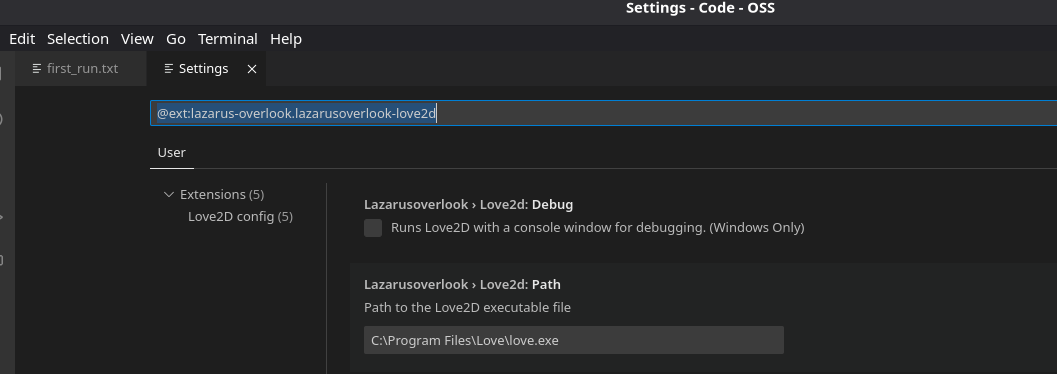
So I’m using the latest version of Manjaro, using the GNOME desktop. I installed Love2d flatpak, and installed VS Code from the website, and then installed love2d support. But the one thing that VS code apparently needs, is the path to the love executable.
I don’t know what I’m doing, but I can’t seem to find the love executable anywhere. I went to /usr/bin, and it’s not there. I looked in other locations, and can’t find it. I know that Love2d is installed because I went to the apps menu, it’s there, and it does load, and you get the balloon with the ‘no game’ message. But I’ve tried every method I know of, to locate the love2d executable, and nothing shows up.
I even did what I thought was a */love search, and nothing showed up. In windows you just go to Program Files, and everything you install is there.
I tried to find the installation log files, but I couldn’t find those either. There was nothing in logs that I could find showing where it actually put the love executable. I must not know how linux actually works in this regard. Any help is appreciated.
You can’t mix normal programs and flatpaks and expect everything to work without tweaking. Flatpaks are containerized. Isolated. So install both as normal apps or both as flatpaks (if the first program support such integration, in which case you will have to allow flatpak1 to access flatpak2)
So I removed the standard version of VS Code, and installed the flatpak version. Now both love2d and VS code are flatpak versions. I installed love2d support. It’s still asking me where the love executable is. How do I find that?
Well the question is if the vscode was made with such usage in mind, i mean, as a flatpak.
You can try to insert the runtime of the love2d in that field, but there is no guarantee it will work.
flatpak list
Will list the flatpaks. Find the full name of this love2d (bla.bla.developer.program.bla.bla) and try to use that. Or flatpak run bla.bla.developer.program.bla.bla
~ flatpak list ✔
Name Application ID Version Branch Installation
Discord …iscordapp.Discord 0.0.119 stable system
Code - O… …alstudio.code-oss 1.74.3 stable system
Freedesk… …edesktop.Platform freedesktop-sdk-25.08.6 25.08 system
Mesa …atform.GL.default 24.0.9 22.08 system
Mesa (Ex… …atform.GL.default 24.0.9 22.08-extra system
Mesa …atform.GL.default 25.2.6 24.08 system
Mesa (Ex… …atform.GL.default 25.2.6 24.08extra system
Mesa …atform.GL.default 25.2.6 25.08 system
Mesa (Ex… …atform.GL.default 25.2.6 25.08-extra system
Codecs E… …form.codecs-extra 25.08-extra system
openh264 …Platform.openh264 2.1.0 2.2.0 system
openh264 …Platform.openh264 2.5.1 2.5.1 system
Freedesk… …g.freedesktop.Sdk freedesktop-sdk-22.08.28 22.08 system
Freedesk… …g.freedesktop.Sdk freedesktop-sdk-25.08.6 25.08 system
GNOME Ap… org.gnome.Platform 48 system
adw-gtk3… …eme.adw-gtk3-dark 6.4 3.22 system
LÖVE org.love2d.love2d 11.5 stable system
Helvum …g.pipewire.Helvum 0.5.1 stable system
There is no executable in this sense of the word, it it created at runtime. You can see for yourself in /var/lib/flatpak/app/ or ~/.var/
But maybe this is an exception of the rule. Check for it. Alternatively try flatpak run org.love2d.love2d
Else i do not know.
ok, one last idea, actually 2. On the official site there are ubuntu packages and appimage. One can extract those and probably use it that way.
Note that you may need to allow vscode to go outside its container to acces the binary - this can easily be done with https://flathub.org/en/apps/com.github.tchx84.Flatseal for example.
So I did that, and it installed, and now there is a ‘love’ executable in /bin/love.
Okay. That solves my problem. I now know the path to the executable and on to the next problem.
That said… can you explain to me how flatpak works….. without an executable? How does it function? My mind is baffled by this idea that you can have a program on your computer… that isn’t there… and yet run it. How does that work? How do you execute a program, that has no executable?
In simple terms, a Flatpak can be started using the command flatpak run org.love2d.love2d, for example. This is also stored in the desktop file. Similar to an AppImage, the OStree repo is mounted and the sandbox is set with bwrap. Then, the binary file is executed on the mounted image under /app/bin/love, for example. It is very similar to APKs on Android.
I might not have been entirely correct on this. For the user programs there is some executable. For example /var/lib/flatpak/app/org.localsend.localsend_app/x86_64/stable/active/files/localsend_app
I actually meant the flatpak runtimes (which the programs depend on, since there are most of the libraries).
But i was not entirely wrong too, because the whole concept is to glue together different binary parts on execution. You can check OSTree, flatpak is build on that concept. I have to say i do not entirely understand all the details of the internals too.