Seems there is no possibility to blacklist an AUR or “normal” paket,
(that is (not yet) installed)
so that it will not and never be installed (without warning!).
I reckon that if it is an AUR script, it will never get installed by any normal maintenance task.
But I am not sure I fully understand what you mean?
You can use pacman.conf to add it to the NoExtract list, as I recall, this will prevent the package from being unpacked onto the system.
In /etc/pacman.conf, you can add package(s) on IgnorePkg = line.
But pacman doesn’t manage AUR, so only Manjaro repos packages. And it may block update and not the first installation …
Meanwhile, I think pamac uses this file too, so it may block AUR package as well, but no warranty on this ! For yay or other package managers, I don’t know.
man pacman says :
     --ignore <package>
         Directs pacman to ignore upgrades of package even if there is one available. Multiple packages can be specified by separating  them  with  a
         comma.
Well, libgdata is an AUR package, so it’ll only get installed on your system if you explicitly install either it, or a package that depends on it. Nothing in the repository depends on libgdata.
But I’m getting the impression that it’s an XY problem, i.e. you are asking about a particular solution to a problem you haven’t divulged. So perhaps you could start telling us why you’re so afraid of getting libgdata on your system in the first place?
Pamac GUI Preferences > Advanced can be used to block updates for installed AUR packages:
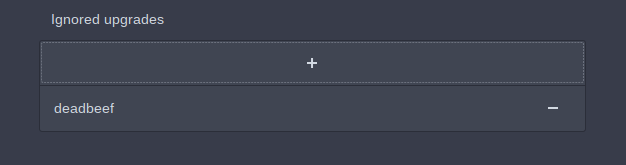
$ grep deadbeef /etc/pacman.conf
IgnorePkg   = deadbeef
But it cannot be used to block an AUR package that is not installed
But as far as I know, most AUR helpers do not build AUR packages without warning. They should provide a summary of packages and dependencies to be installed/built before asking for user authorisation:
$ pamac build libgdata
Preparing...
Checking libgdata dependencies...
Checking libsoup dependencies...
Checking lib32-libsoup dependencies...
Resolving dependencies...
Checking inter-conflicts...

To install (15):
  docbook-xml            4.5-11      (Required By: libgdata)  extra  88.9 kB
  docbook-xsl            1.79.2-9    (Required By: libgdata)  extra  851.7 kB
  glib2-docs             2.88.2-1    (Required By: libgdata)  core   4.5 MB
  gtk-doc                1.36.1-1    (Required By: libgdata)  extra  376.3 kB
  vala                   0.56.19-1   (Required By: libgdata)  extra  2.4 MB
  oniguruma              6.9.10-1    (Required By: libsoup)   extra  227.7 kB
  php                    8.5.8-1     (Required By: libsoup)   extra  5.9 MB
  apache                 2.4.68-1    (Required By: libsoup)   extra  1.8 MB
  php-apache             8.5.8-1     (Required By: libsoup)   extra  4.4 MB
  python-mako            1.3.12-1    (Required By: libgdata)  extra  177.7 kB
  gobject-introspection  1.86.0-2    (Required By: libgdata)  extra  534.8 kB
  python-tqdm            4.69.1-1    (Required By: libgdata)  extra  715.8 kB
  samba                  2:4.24.4-1  (Required By: libsoup)   extra  9.1 MB
  ninja                  1.13.2-3    (Required By: libgdata)  extra  177.5 kB
  meson                  1.11.2-1    (Required By: libgdata)  extra  2.6 MB
To build (2):
  libsoup                2.74.3-4                             AUR
  libgdata               0.18.1-5                             AUR

Total download size: 33.9 MB
Total installed size: 281.3 MB

Edit build files : [e]
Apply transaction ? [e/y/N]
You can create and install a dummy pkgbuild that conflicts with that
pkgname=dummy-no-libgdata
pkgver=2026
pkgrel=1
pkgdesc="Conflicts with libgdata"
arch=(any)
url="https://localhost/"
license=(Unlicense)
conflicts=(libgdata)
That is exactly what I need to prevent dependencies of a paket
(Aur or not AUR) to be installed.
IgnorePkg will not work for NOT installed pakets.
Will try Lolix solution.
Add line: provides=(libgdata)
Install it
- Put it in a directory named
PKGBUILD. - Run:
makepkg -si pacmanwill register it locally, and because it declaresconflicts=(libgdata),
it will be treated as incompatible withlibgdata
dummy, name = PKGBUILD
pkgname=dummy-no-libgdata
pkgver=2026
pkgrel=1
pkgdesc="Dummy package that conflicts with libgdata"
arch=('any')
url="https://localhost/"
license=('Unlicense')
conflicts=('libgdata')
# Uncomment this if you want it to satisfy dependencies on libgdata:
# provides=('libgdata')

package() {
  true
}
(with a little help from an AI)
UNSOLVED:
How to blacklist a normal paket (core, extra,…)
NOT installed ( <==> not yet installed).
You still haven’t explained why you think it would be a good idea to override package manager defaults. 
It could be a preemptive measure, and if so, it is called due diligence.
A deeper explanation may not be required - other than to satisfy our ever growing curiosity into reasons that may be too difficult to explain in a text based forum.

I think the idea that @Lolix posted is brilliant in all simplicity. If anything want to pull the sample package the operator will be alerted by the conflict instead of the library blindly being pulled by yet another custom script.
btw that is not needed
You can do the same with a package from the official repo
Why would there be? Especially repo packages. This sounds like an XY Problem to me as mentioned above.
libgdata is a bad example as it was a repo package that was dropped to the AUR. No one adopted it and was still an orphan when the June AUR attack happened.
If one kept up on removing old orphan packages, nothing would need to be “blacklisted”.
Do not ignore or “blacklist” repo packages. That will put you in an unsupported, partial upgrade state.
Amen
But it is not what this topic is about.
It is about preventing a given AUR script from entering the system.
We are all guilty in neglecting proper maintainance at some point.
Before applying update on stable branch
The AUR incidents is - kind’a - a slap-in-face reminder to regularly run
pamac remove --orphans --unneeded
or
pacman -Qdtq | sudo pacman -Rns -
pacman -Qqd | sudo pacman -Rsu -
From this topic and the recent AUR incidents - I felt the need to do a more generic write-up on package maintance.
The original question(s) looked to me like a more complex problem with more than 2 variables
Pacman or pamac can ignore updates for installed packages but cannot blacklist a package that is not yet installed
Pacman or Pamac should not install packages without warning. They should notify packages to be updated,installed,removed or ignored, and user must agree any changes
The suggestion to create a dummy package is not what was requested by OP, but has been marked as a solution to the underlying problem
libgdata was dropped from Manjaro stable branch 2026-06-26, but the list of package changes is no longer available from the release announcement
I see - a warning may be sufficiant. E.g. I will never use “SSH”.
Or a program that is causing trouble on my system.